
How Bench Warrants Work in Franklin County
A Franklin County bench warrant never appears out of nowhere. It grows out of a case already open at a court, and something went wrong in it: a missed hearing, a summons left unanswered, a court obligation that went unpaid, or an order that was breached. Any of those can move a judge to issue process straight from the bench. Alabama court materials and local municipal records call that process by several names, but the label matters far less than two practical facts: which court issued it and what the live docket says today. A payment window on a ticket, for instance, does not by itself show the paper has been recalled. Rule 3.4 of the Alabama Rules of Criminal Procedure spells out one common path: failure to appear after service of a summons may lead to an arrest warrant. So a bench warrant can put law enforcement in motion even though the trigger was a missed duty rather than a new alleged offense. Anyone checking their own Franklin County bench warrant should ask a pointed question about status. Is it issued, served, recalled, cleared, or still waiting on court action? The docket, not the wording of an old notice, holds that answer.
Franklin County Capias Terms
Phil Campbell offers unusually clear local evidence about court vocabulary. Its official clerk-duty materials name warrants of arrest described as alias, capias, failure to pay, and failure to appear, plus summonses. A capias is simply a court order to take a person into custody or bring them before the court. When an earlier effort fails to secure that appearance, the court issues later process called an alias capias. Same idea, second attempt.
- FTA
- Failure to appear for a set court date or required proceeding.
- FTP
- Failure to pay an amount under the court's order or payment plan.
- Recall
- The court withdraws the warrant from active enforcement status.
- Served
- An officer executed the warrant; service does not end the underlying case.
Franklin County courts may display these terms differently from one another. Read the wording on the actual court record, then ask what action matches it. Paying a ticket alone does not show that a capias has been recalled.
Bench Warrant Issuance in Franklin County
Every Franklin County warrant starts with an underlying case or obligation. A summons or notice tells the person to appear, pay, or comply. Miss that duty, and the judge or magistrate may issue a warrant or writ of arrest under Alabama procedure. From there it can enter court and law-enforcement systems and stay open until it is served or the issuing court takes a formal step such as recall. Alabama's Warrant Management System supports official criminal-justice work, but it is not a public name-search service. The portal requires authenticated access and warns that activity is monitored, so residents should not try to use it. Public confirmation instead begins with the Franklin County Circuit Clerk for District or Circuit matters, the relevant city court for a municipal matter, or the sheriff for questions about service and custody.
Phil Campbell Bench Warrant Records
The Phil Campbell Municipal Court page lays out the town's session and payment framework, and a separate clerk-duty packet states that the clerk maintains an accurate warrant list. That is not a public list, and it exists for the court's own work. What it does show is where to go: the municipal clerk is the direct source for the town's capias, failure-to-appear, and failure-to-pay status. Call Town Hall at 205-993-5313 to reach the court before traveling. Sessions are reported for the third Monday of February, April, June, August, October, and December, with payments due monthly before that third Monday. Anyone unable to pay is directed to contact the court or attend the next session. A pending Franklin County warrant can change those normal rules, though, so ask the clerk directly whether payment, an appearance, counsel, bond, or some other act is required.
Key point: A municipal payment link is not a Franklin County bench warrant database or proof that a warrant has cleared.
How Bench and Arrest Warrants Differ
Both documents can command an arrest, but they start from different places. A bench warrant usually answers a missed duty in a case already before the court. An arrest warrant generally follows an indictment or a judicial finding of probable cause for an alleged offense. The difference shapes which Franklin County papers to gather, which questions to ask, and what the court may require next.
| Feature | Bench Warrant | Arrest Warrant |
|---|---|---|
| Usual trigger | Missed appearance, payment, or court duty | Probable cause or indictment tied to an offense |
| Case setting | Often an existing case | May begin criminal process or follow indictment |
| Franklin contact | The court that set the duty | Issuing court, sheriff, or counsel |
| Status question | Recall, new date, payment, or bond | Surrender, appearance, release, or bond |
The companion Franklin County arrest warrant lookup covers probable cause, contents, and service. Treat neither type as cleared until the responsible court confirms it.
Franklin County Bench Warrant Status
Alabama's blank UTTC-1 court form shows the status fields worth asking about: a warrant-issued date, served date, recalled date, bond information, conditional or final bond forfeiture, and a UTTC-6B clearance entry. It is a schema, not a filled Franklin County record. Not every field is public. Still, it hands you the vocabulary for a focused clerk call.
| Case or ticket | The identifier connecting the warrant to the correct court matter. |
|---|---|
| Issued date | The date the court entered the warrant. |
| Served date | The date law enforcement executed it, if applicable. |
| Recalled date | The court's recorded withdrawal of the warrant. |
| Bond status | Any amount, cash entry, or forfeiture stage recorded by the court. |
| Clearance | A traffic-related status entry that should be confirmed with the issuing court. |
A receipt answers only the payment question. Ask the Franklin County clerk whether the warrant itself shows recalled or cleared, when that update reaches law enforcement or ALEA, and whether written proof exists.
Clearing a Bench Warrant in Franklin County
Franklin County has no online bench-warrant clearing tool. There is no standard recall form either. The issuing court picks the fix: an appearance, a payment, a motion, proof of compliance, bond, or a lawyer-handled step. Call before you arrive or send funds. Once a capias is active, a routine payment method may not apply.
- Find the court, case number, ticket number, and date on the notice or prior paperwork.
- Call that court through an official site and ask for the current warrant and docket status.
- Ask whether counsel may appear and whether payment, bond, or a new date is required.
- Confirm the payee, payment form, location, identification, and receipt process before acting.
- After compliance, ask whether the warrant is recalled and how clearance reaches other agencies.
Caution: Do not ignore a bench warrant or assume a fine payment automatically recalls it; obtain direct confirmation from the issuing court.
Franklin County Clerk Warrant Route
The Franklin County Circuit Clerk runs a Warrants division and serves as record keeper and business manager for the Circuit and District Courts. Its official page lists the divisions and how to reach them. The office is at 410 N. Jackson Avenue in Russellville. The listed phone is 256-332-8861. Weekday hours run 8:00 a.m. to 4:30 p.m. Clerk staff can route a record question, but they cannot give legal advice.
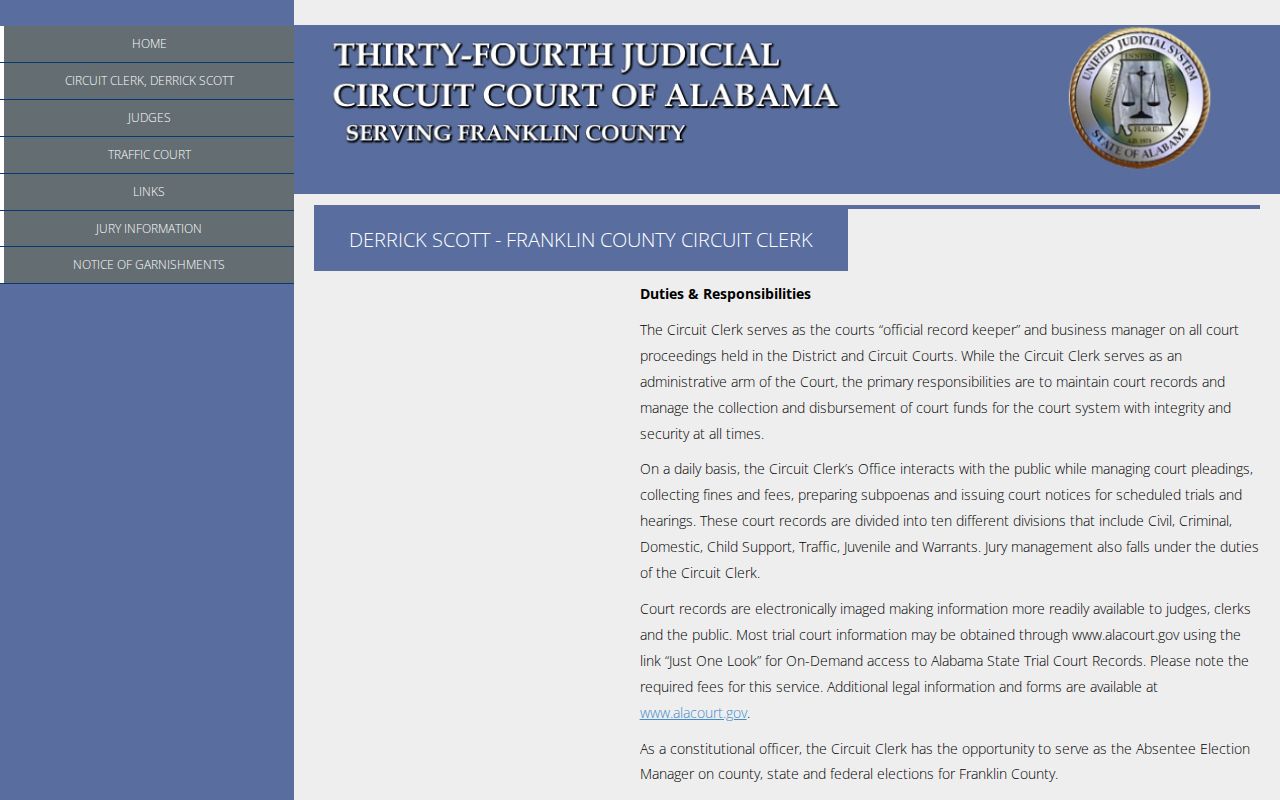
Check the court named on the paperwork. A city case belongs to that city. The Franklin County clerk handles county Circuit and District matters, so do not assume the office holds a municipal file.
Franklin County Courts That Issue Bench Warrants
County cases start with the Franklin County Circuit Clerk at 256-332-8861. District Court answers at 256-332-8886. City matters divide up. Russellville Municipal Court lists 256-332-8700, Phil Campbell uses 205-993-5313, and Red Bay routes through City Hall at 256-356-4473. Vina and Hodges post no municipal-court or warrant portal. Their town halls can say which court issues warrants there now. The court on the notice controls the docket. The Franklin County Sheriff's Office, at 256-332-8820, handles service and custody routing. It cannot be assumed to recall a judge's warrant. The sheriff's Most Wanted page is curated, not a full bench-warrant list, so absence from it or from the jail roster proves nothing.
Franklin County Bench Warrant Bonds
If the court or jail says bond applies, follow the Franklin County Detention Center instructions. Confirm by phone at 256-332-8425. The official page lays out cash, property, and licensed bail-bondsman paths. A cash bond is paid at the clerk's office. Then the receipt goes to the jail. A property bond takes an assessment printout plus the signatures of everyone on the assessment. Each bond also carries a $35 filing fee. Pay it by money order to Franklin County Circuit Clerk. No cash or personal check works for that fee. None of this promises that every Franklin County bench warrant allows immediate bond or release. Ask whether a judge must set the amount first, and what court duties remain after posting.