
How Arrest Warrants Work in Franklin County
In Franklin County, an arrest warrant begins with paper and a judge. Alabama Rule of Criminal Procedure 3.1 ties it to an indictment or a finding of probable cause, which simply means a sound factual basis to believe an offense happened and that a named person committed it. Rule 3.2 then sets the warrant's required contents: it must identify the person and the offense, and it must command an officer to arrest that person and bring them before a judicial officer. The structure is straightforward once you see it. Two trial courts split the work here. The Circuit Court of Alabama, 34th Judicial Circuit handles felonies and broader trial matters, while District Court takes lower-level criminal and preliminary cases, and municipal courts issue process in city cases. The Franklin County Circuit Clerk keeps both Circuit and District records and runs a Warrants division. Keep the roles separate in your mind. The issuing court controls its docket; the sheriff and police handle service and custody within their lawful roles.
Franklin County Arrest Warrant Checks
Franklin County publishes no full warrant list and no public status portal for civilians. So start with whatever paper names the court: a notice, bond paperwork, a summons, or a prior case record. The 34th Judicial Circuit court site posts the numbers you need, including the Circuit Clerk at 256-332-8861, District Court at 256-332-8886, and Circuit Court at 256-332-8893. Call and ask what can be confirmed for your own matter, and whether you should appear or bring counsel.
- Check paperwork for the court, county or city, case number, and offense.
- Call the issuing court through its official government or court page.
- For service or custody routing, call the Franklin County Sheriff at 256-332-8820.
- For a city case, contact that municipal court rather than assuming the county clerk has it.
- Ask how current status, appearance, surrender, release, and bond will be confirmed.
Alabama's Warrant Management System stays closed to everyone but official law-enforcement and criminal-justice users. It is not a public fallback. The Franklin County sheriff's Most Wanted page is incomplete by design too, so a missing name there clears no one.
Arrest Warrants: What They Contain
Alabama's CR-6 complaint and warrant form offers a clean model of what a warrant record holds. It shows, field by field, how identifiers, sworn facts, and judicial action tie a complaint to the warrant itself. What it does not show is which fields become public before service, since a blank form is never a search result. Franklin County's own warrant-number format is not published, so treat any sample number you see elsewhere with caution.
| Warrant number | A court identifier; use the exact value on official paperwork. |
|---|---|
| Case number | The docket identifier connecting the warrant to a court case. |
| Court and county | Franklin County Circuit or District Court, or the named municipality. |
| Named subject | The defendant's name or identifying description on the official form. |
| Offense and date | The alleged offense and occurrence information stated in the complaint. |
| Probable-cause facts | The sworn factual statement supporting issuance. |
| Judicial signature | The issuing judicial officer's signature and title. |
| Bond provision | An appearance-bond or own-recognizance provision when the court includes one. |
These fields help a caller match the right file at the Franklin County clerk's window. Do not pull them from an unofficial page. And never send them through an ordinary email form that itself warns against sensitive data.
Franklin County Warrant Form Sources
The Alabama court system's criminal forms index gathers blank complaint, warrant, release, surrender, and rights forms in one place. It teaches the state's record structure without exposing any live defendant. That is its whole value here. It is not a Franklin County lookup, and nothing in it should be filled out or filed unless the court itself directs that step. The index's own page lists each form and its current revision.
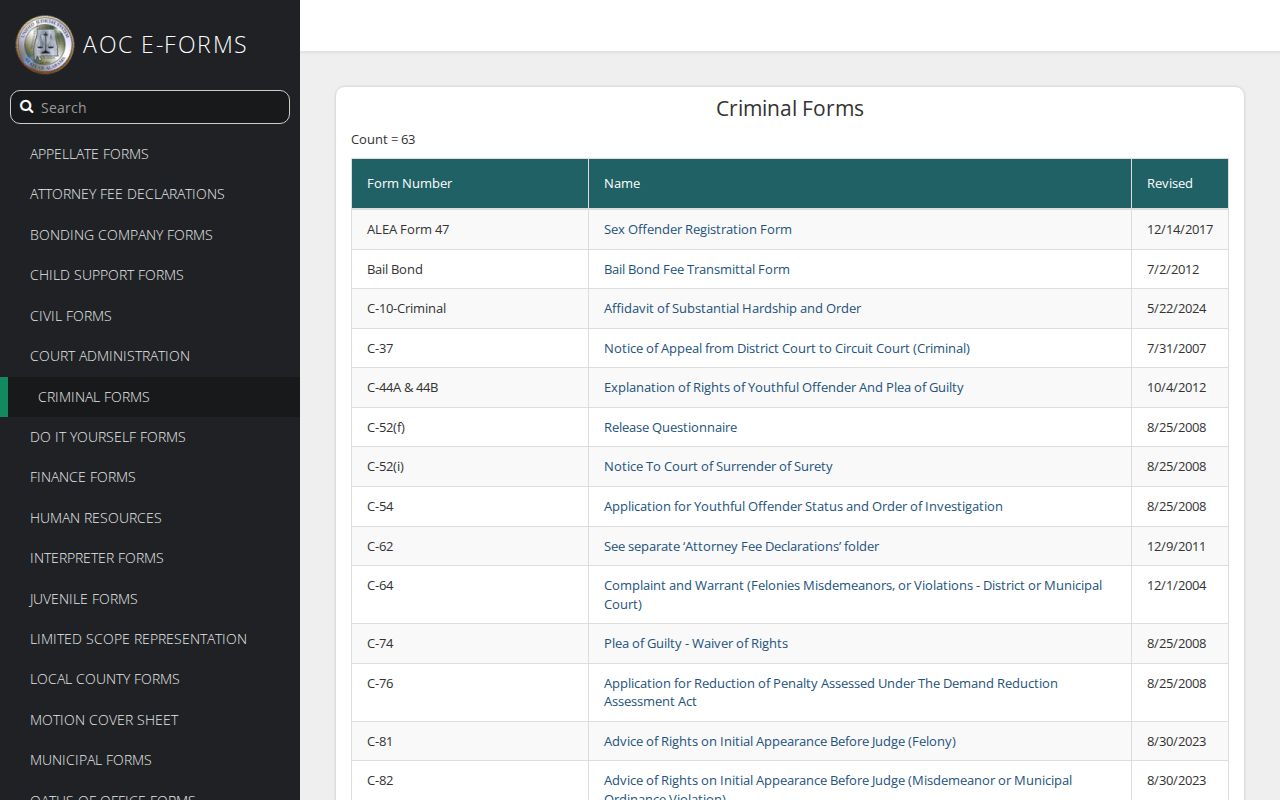
The index supports sharp questions about the complaint, warrant, bond, surrender, and release stages. Still, the Franklin County clerk or court must say which form, if any, fits a specific matter.
How Warrants Get Served in Franklin County
Rule 3.3 allows an arrest warrant to be directed to any law-enforcement officer serving within Alabama. The rule's supporting notes name sheriffs and deputies, constables within a county, and municipal police or marshals within their city or town. Once the officer executes a Franklin County warrant, they make a return, which is the record showing the command was carried out. That return matters. Alabama Code §15-10-2 covers the officer's duty to inform the person and to show the warrant when required, plus the legal rules for entry after notice and refusal. None of it licenses self-help. Nobody should try to execute, cancel, or interfere with a warrant. If you believe one exists, get advice, then ask the court or the sheriff about a lawful appearance or surrender route.
Safety note: Do not confront another person about a warrant or interfere with an officer; use official court and sheriff channels.
Franklin County Unserved Warrant Access
The Alabama Open Records Act gives residents a general right to inspect and copy public records, subject to exemptions and security limits. That right does not open every unserved warrant or the complaint beneath it. Alabama's official Open Records Resource Manual discusses an Attorney General view that a complaint supporting an unexecuted arrest warrant stays closed, while an executed warrant and complaint may later become public. So the custodian matters as much as the request. The Franklin County Commission's request form covers only records in Commission custody and cannot replace sheriff or court process. Route Circuit and District court records to the Franklin County Circuit Clerk. Route city cases to the municipal court. Ask the sheriff about sheriff-held records, and remember that juvenile and youthful-offender records carry separate statutory limits.
Access limit: A lawful record restriction or absent web result says nothing conclusive about whether a Franklin County arrest warrant exists.
Arrest Warrants, Summonses, and Bench Warrants
A summons tells a person to appear in court and orders no arrest. Skip that appearance, though, and Alabama Rule 3.4 says the result can be an arrest warrant. A bench warrant, or capias, usually follows a missed court duty in a case already open. An arrest warrant more often grows out of probable cause or an indictment tied to an alleged offense. Each one demands a different status question in Franklin County, so name the paper before you ask about it.
| Feature | Arrest Warrant | Summons | Bench Warrant |
|---|---|---|---|
| Command | Arrest and bring before a judicial officer | Appear at the stated time | Arrest after a missed court duty |
| Basis | Probable cause or indictment | Notice to answer a charge | Failure to appear, pay, or comply |
| First contact | Issuing court, sheriff, or counsel | Court named on the summons | Court that set the missed duty |
| Key question | Surrender, appearance, release, and bond | Date, place, and required response | Recall, new date, payment, or bond |
An outstanding capias can be recalled once the court orders it, and the Franklin County bench warrant lookup traces that process. The docket, not the label on the paper, decides what happens next.
Franklin County Search Warrant Difference
A search warrant works differently from an arrest warrant. Alabama Rules 3.8 and 3.10 set out probable cause to search a described place, person, or object for property or evidence. Those rules also cover service time, inventory, and return. An arrest warrant does something else. It commands an officer to take a named or described person into custody and bring that person before judicial authority. One investigation in Franklin County can produce both documents. Still, neither one proves the other exists. A press release about a search warrant is not a personal arrest-status result. The sheriff's detention roster, likewise, shows who has been booked, not whether a still-active arrest warrant sits on the issuing court's docket in Franklin County.
Handling an Arrest Warrant in Your Name
Start by confirming the issuing court through official contact information. Then consider an attorney before you appear or surrender. Ask the court or sheriff what place and time apply, whether counsel may appear, what identification is needed, and whether a judge must set bond. Ignore payment demands that arrive by text, social post, or unexpected call. Those prove nothing. If detention and bond enter the picture, call the Franklin County Detention Center at 256-332-8425. Its official bond instructions cover cash, property, and licensed bail-bondsman routes. A cash bond is paid at the clerk's courthouse office, and the receipt goes to the jail. A property bond needs a Revenue Commissioner assessment plus signatures from everyone named on it. Every bond also carries a $35 filing fee. Pay that fee by money order to the Franklin County Circuit Clerk.
Important: Seek legal advice before surrendering; only the issuing court and authorized officers can state the current arrest-warrant and bond procedure.